It is the first question almost every customer asks once the truck pulls away: when can I actually use this? In Phoenix the answer is not the same as it is anywhere else, because our heat changes the chemistry of what is happening in the slab.
The short version: you can usually walk on new concrete in 24 to 48 hours, park a car on it after 7 days, and consider it fully cured at 28 days. But those numbers only hold if the slab is cured properly. In a Phoenix summer, that part is not automatic.
People use these words interchangeably, and it causes a lot of confusion.
Setting is the concrete going from liquid to solid. It happens in the first few hours.
Curing is the chemical reaction, called hydration, where cement and water bond and the slab actually gains strength. That reaction needs moisture, and it keeps going for weeks.
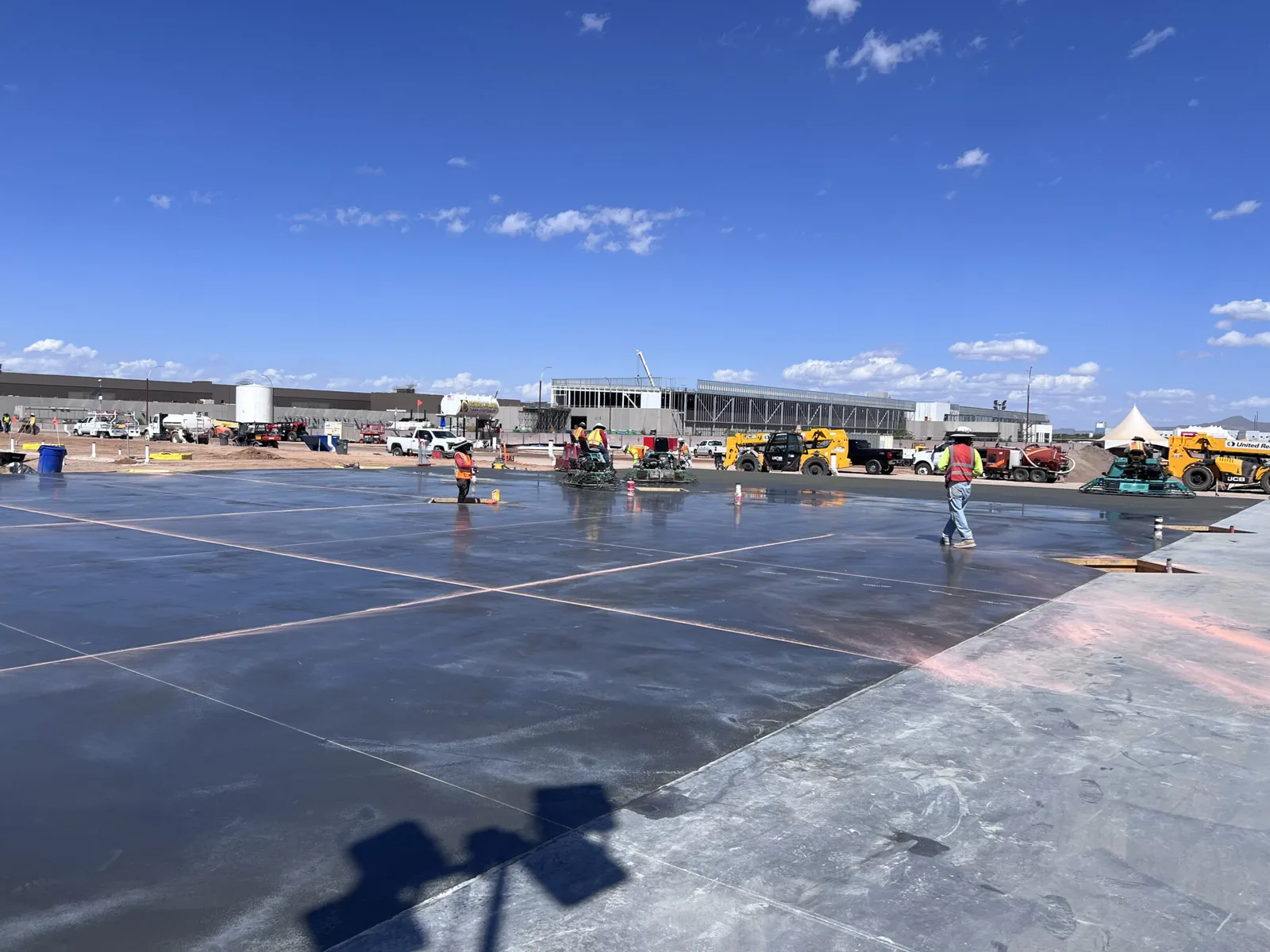
Here is the part that catches people out: heat speeds up setting but works against curing. When the surface dries too fast, the water needed for hydration evaporates before it can do its job. You end up with a slab that feels rock hard on day two and is genuinely weaker than it should be for the rest of its life.
Concrete keeps gaining strength slowly for years after that, but 28 days is the number every spec in the industry is written around.
The enemy is not really temperature on its own. It is the evaporation rate, which is temperature, wind, humidity and the temperature of the concrete itself all working together. A 108°F afternoon with 8% humidity and a breeze pulls water out of a slab surface astonishingly fast.
When water leaves the surface faster than bleed water rises to replace it, the top of the slab shrinks while the concrete underneath is still plastic. That tension has to go somewhere, and it shows up as plastic shrinkage cracking — those short, random, hairline cracks that appear within hours of a pour and have nothing to do with the ground settling.
It is entirely preventable, and it is one of the clearest signs of whether a crew knows what it is doing in this climate.
These are the standard hot weather practices, and we plan around them from May through September:
If a driveway or patio was poured in summer and cured badly, it usually tells on itself within the first year:
Some of this is cosmetic and some of it means the top layer is genuinely weak. If you are seeing it, it is worth having someone look before it progresses. We cover this in more detail on our concrete repair and maintenance page.
Do not judge new concrete by how hard it feels. A slab that set fast in 110°F heat can be weaker than one that took its time in October. What you actually want to ask your contractor is how they plan to cure it — and if the answer is vague, that tells you something.
Planning a driveway, patio or slab this summer? We pour year-round in the Valley and adjust the schedule and the mix to the conditions. Get a free quote or call us at (623) 303-2333.