Concrete gets poured in Phoenix all twelve months of the year. But if you have the flexibility to choose when, the season genuinely affects how easy the job is, how good the finish looks, and how long the slab lasts.
If you want the short answer: October through April is the sweet spot in the Valley.
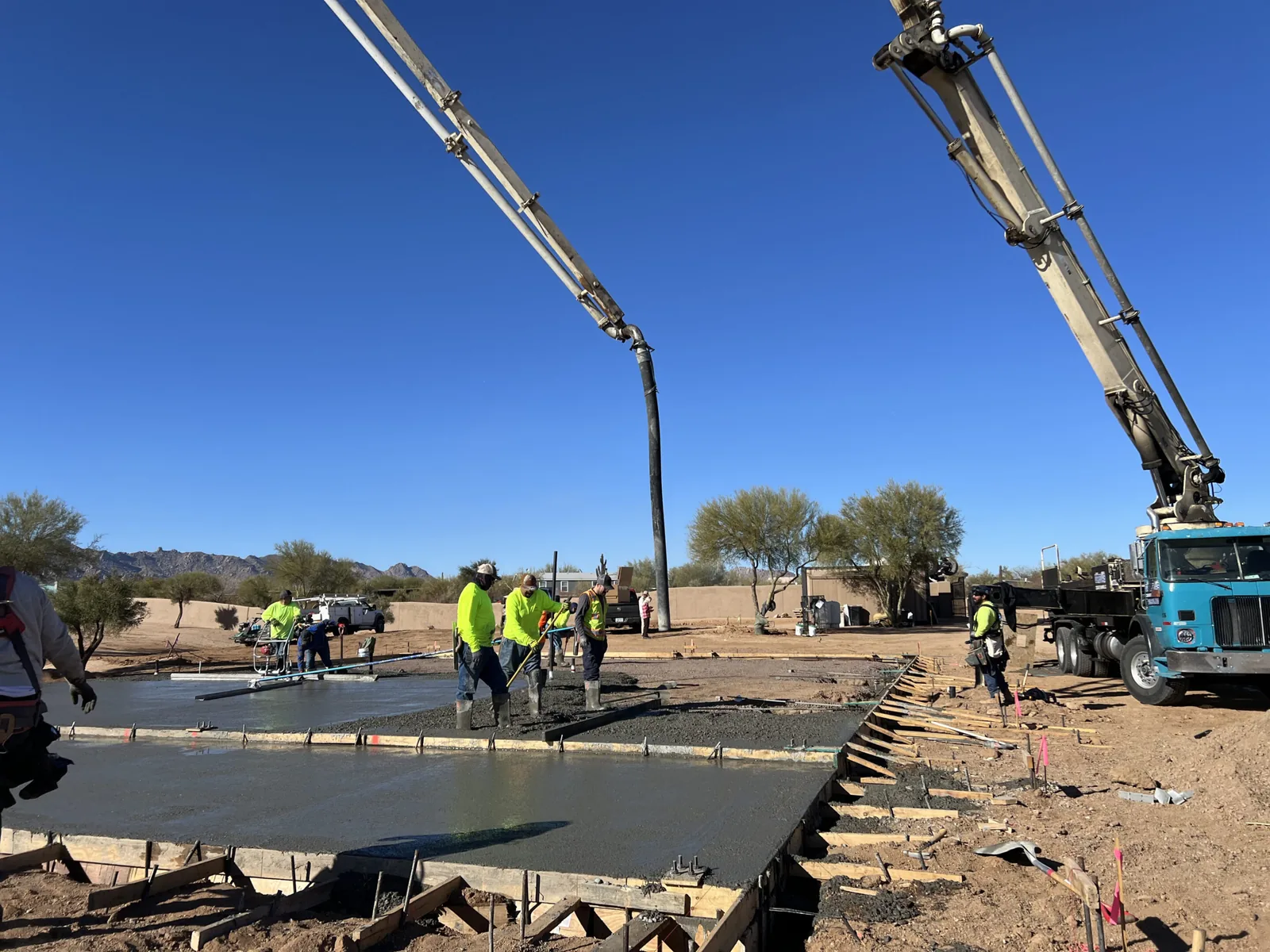
From roughly October to April, daytime highs sit in a range where concrete behaves the way the mix was designed to behave. Moderate temperatures mean a normal working time for the crew, a slower and more complete cure, and far less risk of the surface drying out before it has gained strength.
Practically, that means:
October and November in particular are close to ideal. They are also busy — if you are planning a fall project, booking early is worth doing.
June through September is the hard season. Surface temperatures on the subgrade can exceed air temperature by a wide margin, humidity is often in single digits, and the evaporation rate off a fresh slab is severe.
None of this makes summer pours impossible. It makes them dependent on process. A well-run summer pour means an early start, a cooled mix, a dampened subgrade, shade and windbreaks, an evaporation retarder during finishing, and disciplined curing afterward. We go through the reasoning behind all of that in our post on how long concrete takes to cure in Phoenix heat.
What we would not do is pour a large decorative slab at 2pm in July because that was the first opening on the calendar. Some jobs are worth moving.
Roughly mid-June through September, Phoenix gets monsoon storms — and they are a different challenge from the heat.
Fresh concrete and a sudden downpour do not mix. Rain landing on a slab that has not yet set can wash cement paste off the surface, leaving it weak, pitted and discolored. Rain on unset concrete is one of the few things that can genuinely ruin a pour rather than just complicate it.
The other monsoon issue is the ground. Heavy runoff can undermine a subgrade that was compacted perfectly a day earlier. If the base moves, the slab above it eventually cracks.
During monsoon season we watch the forecast closely and will reschedule a pour rather than gamble on it. A day of delay is cheaper than a slab that has to come out.
People moving here from colder states often assume winter is off-limits. In the Valley it usually is not. Hard freezes are rare at these elevations, and December and January frequently give you excellent pouring conditions.
The thing to watch is overnight lows. When temperatures approach freezing, water in fresh concrete can freeze before the slab has developed enough strength to resist it, which causes real damage. Below about 40°F, concrete also cures much more slowly — so the timeline stretches and you wait longer before using the slab.
On cold nights the fix is straightforward: insulating blankets over the slab, and scheduling the pour for late morning so it has daylight hours to gain strength. Worth noting that higher-elevation Arizona — Flagstaff, Prescott, the White Mountains — is a completely different situation with real freeze cycles. This advice is specific to the Phoenix metro.
Not directly, in the sense that we do not charge a summer premium. What season affects is scheduling. Fall books up, so lead times stretch. Summer often has more availability. If your project is flexible on dates and you are not doing intricate decorative work, a well-managed summer pour can get you on the calendar sooner.
Thinking about a new driveway, patio or slab? Tell us what you have in mind and we will give you an honest read on timing. Request a free quote or call (623) 303-2333.